

Is anyone familiar with John Rachel’s An Unlikely Truth? I haven’t read it, but I’m told the author is some sort of sortition fan.
Filed under: Books, Elections, Proposals, Sortition | Leave a comment »

Is anyone familiar with John Rachel’s An Unlikely Truth? I haven’t read it, but I’m told the author is some sort of sortition fan.
Filed under: Books, Elections, Proposals, Sortition | Leave a comment »
Dear Prof. Gilens,
My name is Yoram Gat.
I recently became aware of your new paper “Testing Theories of American Politics: Elites, Interest Groups, and Average Citizens ” expanding on your previous work (“Inequality and democratic responsiveness”, 2005).
I see the findings of this work, as I presume you do, as confirming the widespread public sentiment, consistently measured in many opinion polls and expressed for example in the 2011 “Occupy” protests, that the American system does not represent the majority of Americans (“the 99%”). I also presume that the American system is not unique in this respect: 2011 has seen protest around the world reflecting similar sentiments in other societies governed by similar systems.
Continue reading
Filed under: Academia, Action, Elections, Opinion polling, Proposals, Sortition | 8 Comments »
Keith McDonnell and Terry Bouricius wrote to point out the following.
Martin Gilens and Benjamin Page have a new paper titled “Testing theories of American politics: elites, interest Groups, and average citizens”. The paper continues the work of Gilens analyzing the correlation between public opinion and policy (see his 2005 paper “Inequality and democratic responsiveness” and a book on the same theme, Affluence and Influence: Economic Inequality and Political Power in America).
The previous work found that any correlation between public sentiments and policy is completely mediated by elite opinion (where “elite” is defined as top decile of income). The new paper adds to the analysis the position of interest groups and again finds that elites dominate policy making. The abstract is as follows:
Abstract
Each of four theoretical traditions in the study of American politics – which can be characterized as theories of Majoritarian Electoral Democracy, Economic Elite Domination, and two types of interest group pluralism, Majoritarian Pluralism and Biased Pluralism – offers different predictions about which sets of actors have how much influence over public policy: average citizens; economic elites; and organized interest groups, mass-based or business-oriented.
A great deal of empirical research speaks to the policy influence of one or another set of actors, but until recently it has not been possible to test these contrasting theoretical predictions against each other within a single statistical model. This paper reports on an effort to do so, using a unique data set that includes measures of the key variables for 1,779 policy issues.
Multivariate analysis indicates that economic elites and organized groups representing business interests have substantial independent impacts on U.S. government policy, while average citizens and mass-based interest groups have little or no independent influence. The results provide substantial support for theories of Economic Elite Domination and for theories of Biased Pluralism, but not for theories of Majoritarian Electoral Democracy or Majoritarian Pluralism.
Filed under: Academia, Books, Elections, Opinion polling, Participation | 5 Comments »
Another blog posting from Italy has appeared regarding sortition. This time, the focus is on strategizing how best to spread the word. It advocates focusing upon the limitations of voting. See–
Filed under: Elections, Sortition | 2 Comments »
Dissoi logoi, a Greek book usually dated to the end of the 5th century BC, has the following argument about sortition, whose first part is quite similar in both content and form to the argument attributed to Socrates by Xenophon in Memorabilia. The second part is reminiscent of the argument made by Isocrates in Areopagiticus.
VII. [No Title]
(1) Some of the popular orators say that offices should be assigned by lot, but their opinion is not the best. (2) Suppose someone should question the man who says this as follows: Why don’t you assign your household slaves their tasks by lot, so that if the teamster drew the office of cook, he would do the cooking and the cook would drive the team, and so with the rest ? (3) And why don’t we get together the smiths and cobblers, and the carpenters and goldsmiths, and have them draw lots, and force each one to engage in whatever trade he happens to draw and not the one he understands ? (4) The same thing could also be done in musical contests: have the contestants draw lots and have each one compete in the contest he draws; thus the flute-player will play the lyre if that falls to his lot, and the lyre-player the flute. And in battle it may turn out that archers and hoplites will ride horseback and the cavalry-man will use the bow, with the result that everyone will do what he does not understand and is incapable of doing. (5) And they say that this procedure is also not only good but exceptionally democratic, whereas I think that democratic is the last thing it is. Because there are in cities men hostile to the demos, and if the lot falls to them, they will destroy the demos. (6) But the demos itself ought to keep its eyes open and elect all those who are well-disposed towards it, and ought to choose suitable people to be in command of the army and others to be the law-officers, and so on.
Filed under: Athens, Books, Elections, History, Sortition | 31 Comments »
A letter I wrote to Dave Meslin:
Hi Dave,
My name is Yoram Gat. I recently viewed your TED talk “The antidote to apathy” and found it relevant to my own political thoughts and activity and wanted to see if I could interest you in those.
To start with, I share what may be called your democratic outlook: contrary to conventional wisdom people are not inherently apathetic, selfish or lazy. People respond to the situations in which they are. If they have no effective ways to make an impact, they will not bother making silly gestures pretending that they are meaningful. This manifests itself as “rational ignorance” or “rational passivity”. Such behavior is then being misrepresented as apathy.
Continue reading
Filed under: Elections, Participation, Press, Sortition | 6 Comments »
Liberation has an interview with David Van Reybrouck by Béatrice Vallaeys about his sortitionist message.
An automatic translation of the preamble with my touch ups:
To counter distrust toward politics, Belgian historian and writer David Van Reybrouck advocates deliberative democracy, where allotted citizens lend a hand to elected officials.
“We despise elected officials, we venerate the elections.” Thus says David Van Reybrouck in a recently published essay, Against elections. Born in 1971 in Bruges, David Van Reybrouck strives with an undeniable talent to demonstrate “a fatigue of Western democracy”, but he also offers a remedy: instead of the appointment rituals where people are invited to cast their votes for a particular candidate, he proposes the creation of an allotted legislature. “The realities of our democracies disillusions people at an alarming rate. We must ensure that democracy does not wear itself out,” he says, convinced that elections are a cause of paralysis of democracy. His credo: not only the right to vote, but the right to speak.
Filed under: Books, Elections, Press, Proposals, Sortition | Tagged: David Van Reybrouck, democracy, elections, fatigue, sortition | 20 Comments »
Voice of the People describes itself so:
Voice Of the People (VOP) is a new non-partisan organization that seeks to re-anchor our democracy in its founding principles by giving ‘We the People’ a greater role in government. VOP furthers the use of innovative methods and technology to give the American people a more effective voice in the policymaking process.
Continue reading
Filed under: Academia, Elections, Participation, Proposals, Sortition | 15 Comments »
A recent segment on the BBC radio show Analysis is titled “The Philosophy of Russell Brand”. The audience is warned ahead of time to hold on to their hats as “Jeremy Cliffe enters a world without rules, without government, but with plenty of facial hair”. Following this introduction, and the expected sound bites from the Brand-Paxman interview, the segment talks about the attention Brand received, the Occupy/Indignados protest movement and features interviews with Paolo Gerbaudo, David Graeber, Michael Hardt, Peter Turchin, Daniel Pinchbeck, and a few friends of Cliffe.
Continue reading
Filed under: Academia, Athens, Elections, History, Juries, Participation, Press, Proposals, Sortition, Theory | Tagged: Analysis, anarcho-populism, David Graeber, direct democracy, Indignados, Jeremy Cliffe, localism, Occupy, Peter Turchin, Russell Brand | 20 Comments »
Paul Lucardie sent the following excerpts from his new book ‘Democratic Extremism in Theory and Practice. All power to the people’ (London: Routledge, 2014).
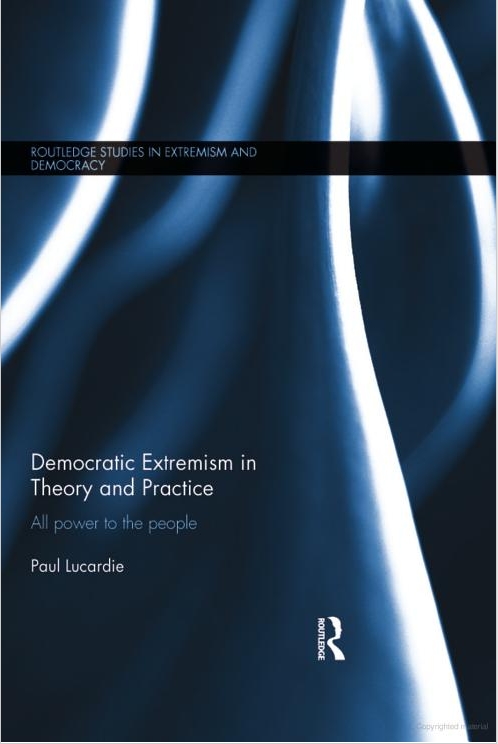
Author’s comment: Democratic extremism may appear to be an oxymoron, as ‘democracy’ is usually associated with moderation, pluralism and tolerance. Yet one could also regard democratic extremism as the opposite of autocratic and aristocratic extremism: whereas the latter imply that all decisions are taken by a dictator, a class of landowners or perhaps (in a more modern variety) the Central Committee of a ruling Communist Party, the former means that all decisions are taken by the people and that a political elite does not play any significant role. Examples of extreme democracy are rare, as far as I could find out. More common are cases of what I would call radical democracy: not all decisions but most important decisions are taken by the people, some are left to a political elite. Even more common, however, are mixed regimes where most decisions are taken by an elected aristocracy (professional politicians) and some by the people. In fact most so-called representative democracies are, in my opinion, mixed regimes, if not elective aristocracies.
Continue reading
Filed under: Academia, Books, Elections, Sortition | Tagged: Democratic extremism, Paul Lucardie, radical democracy | 45 Comments »
 Adam Cronkright
 Ali
Ali Ahmed R. Teleb
 avanderven
 avergne
 Alex Kovner
 azakaras
 Brett Hennig
 campbellwallace
 Simon Threlkeld
 Nick Coccoma
 codyhipskind
 Common Lot Sortitionist
 Conall Boyle
 constitutionalism
 davidschecter
 Ethan McCutchen
 graytmatter
 gtridimas
 Henry Tuttle
 H.J. Hofkirchner
 HpR
HpR James Kierstead
 John Burnheim
 jgarry20151
 Jochen Krattenmacher
 johnedwardtaylor
 johnhuang865
 Jonathan Crock
 keithsutherland
 Jacob Richter
 kkoreilly
 lukewhito
 SimonPek
 Nathan El
 Nicholas Gruen
 Owen Shaffer
 Patrick Chalmers
 Paul Gölz
 peterstone
 Pierre-Etienne Vandamme
 pronfeld
 Emil
Emil rcaze
rcaze richwbrown
 Roger Knights
 roslynfuller
 Pierre-Etienne Vandamme
 shaharavin
 tbouricius
 Ted Wachtel
 Joshua Laferriere
 theodorestathis
 towardsautonomyblog
 Wayne Liebman
 Yoram Gat
 Oliver Milne
