Why Chance Matters

Just saw the following event announced on PHILOS-L. Anyone know the speaker?

*****

Why Chance Matters
with Prof. Mauricio Suárez
(Complutense University of Madrid & UCL)

Tue 12 April, 18.00 (drinks from 17.45)
@The Conservatory, Bloomsbury Publishing
50 Bedford Square, London.

Organised by UH Philosophy & Bloomsbury Philosophy

Free entry- all welcome – no booking required.
Please arrive early to secure a seat and enjoy a drink on us!

Facebook group for the event: https://www.facebook.com/events/463239327215030/

Abstract

Chance has been raising intellectual passions at least since the concept of probability emerged firmly in the 17th century, in connection with both evidence in jurisprudence and regularities in so-called “games of chance”. Probabilistic thinking soon spread everywhere: from actuarial science to population statistics, from the calculus of expectations to decision theory, from measures of experimental error to quantum mechanics. Ideas of pure chance and randomness infected general culture and even the arts. Yet, there have been many attempts to deny the reality of chance. Those in denial have typically tried to explain away chance in terms of something else, something less “fickle”, “elusive” or “ephemeral”. But there is deep disagreement as to what that something else may be. Objectivists aim to analyse chance in terms of proportions in real or virtual populations. Subjectivists aim to analyse it away as a feature of the architecture of cognition – such as information, or partial degree of belief. Yet none of these denials of chance seems to apply across the board and, as I show, they are all subject to important conceptual objections anyway. I conclude that chance matters, not only to many areas of philosophy but also to social policy, and how we conduct our lives in general.
Continue reading →

Publicity, conformity and change

I’ve been having an email exchange with Yoram about how to ensure that people in various roles act as that role requires. Basically my answer is to ensure that what they do is completely open to public scrutiny and assessment.

Yoram replies that the standards in terms of which those assessments are made are set by the establishment. So the scrutiny only serves to keep the bearers of those roles serving the interests of the establishment.

I reply that there are contexts in which that is largely true, but plenty of others where it is not, especially where there is constant open debate about the ruling conventions in particular matters. Discussion of them in completely general terms is mostly futile. Anybody who has had a long life in recent time has very many examples of complete reversals of the accepted conventions in many areas of life arising from small groups of activists succeeding in changing people’s opinions. The establishment had hardly anything to do with it. For the most part it resisted the changes quite unsuccessfully, in spite of raising fears that society was falling apart.

Where the establishment has usually been much more successful is in the case of strictly institutionalised activities like economic and political structures. Mere changes of opinion have much less effect on them. The difference is obvious. Where what people do is dependent only on their personal compromise between what they would like to do and what they think they ought to do, as in matters of sex, parenting, lifestyle, education, leisure and so on, although they are influenced by existing conventions, if enough people choose to defy or evade them, the conventions soon crumble. In many cases the result is to entrench an entirely new convention.

In strictly institutionalised roles, however, the people in those roles enjoy no such freedom. If they do not conform closely to what is expected of them, they are strongly penalised or ejected from that role. If changes are to be made in those roles, they come, not from changes of opinion among the occupants of the roles, but from those who control the sanctions and choose the employees who get to work under them. In a changing world, however, the establishment does need to change, to adapt to new conditions if they are to survive. Rigidly static organisations inevitably destroy themselves.in the long run. Even in the short run they are grossly inefficient and costly.
Continue reading →

Rousseau’s Mistake

A recent article by Hélène Landemore:

Rousseau’s Mistake: Representation and the Myth of Direct Democracy

Abstract: For Rousseau, democracy was direct or it wasn’t. As he famously put it, “the moment a people allows itself to be represented, it is no longer free: it no longer exists. The day you elect representatives is the day you lose your freedom” (Social Contract, III, 15). In other words, representative democracy is no democracy at all. Rousseau isn’t alone in this belief, and today the disappointed of representative government have turned to celebrating anew the virtues of direct democracy as more true to the ideal of popular sovereignty, self-rule, and genuine political equality. This paper defends the thesis that Rousseau was, in fact, mistaken and that there is no salvation to be found in the ideal of direct democracy. If democracy as a political regime is always, in fact, representative, then the interesting question is not: direct or representative democracy? But instead: What kind of representation should we aim for? The paper argues that beyond the familiar electoral model there are at least two other models of representation that present attractive features: the first is based on sortition and the other on self-selection.

Continue reading →

Representation and what it’s for

Focussing on the importance of tackling specific problems is the key to my claim that in that way we have a much better chance of achieving a broad consensus on what needs to be done in each of those matters. Only such a consensus can lead to that decision being seen as public good, not just a necessary evil.

I further assume that what we want in each case is to get a sound solution to that particular problem. Accordingly I conclude that when it comes to deciding, after full public debate, what is the best solution in the circumstances, the people most likely to reach a good decision are those who, in different ways, are most directly and substantially affected by the outcome. They have to face the actual consequences of a decision. They cannot afford to give too much weight to merely expressive considerations, as people making decisions about public goods are apt to do.

If we care at all about public policy, it is inevitable that we will want it to express the sort of values and aspirations that we would like our social arrangements to exemplify. That is the case in any kind of regime, theocracy, monarchy, aristocracy or democracy. Indeed people accept authoritarian regimes mainly because they think those authorities can deliver the sort of social order they want, because of their religious, social or other beliefs, which all proper members of the community ought to share. The vice of all such authoritarianism is that it substitutes coercion for persuasion, which is the proper driving force of culture. But persuasion is open to change and the orthodox see change as inevitably for the worse
Continue reading →

Policy and representation

There are two activities that go under the heading “Public Policy”, one that concentrates on political processes, as we do here on this website, and the other that is the focus of university departments of Public Policy and numerous professional associations. The first group (call them PPs) are concerned with political processes of arriving at political decisions, the second (call them PNs) with identifying needs in the community and devising means of satisfying those needs.

The two hardly ever engage with each other. If they did, the PPs would no doubt say to the PNs: you are at best just paternalists, patching up holes in the status quo, arrogating to yourselves decisions about what others need. To which the PNs might reply: you PPs are just entrenching the power of existing adults to suit yourselves. You completely neglect the fact that the young are in no position to understand what lies ahead of them and many disadvantaged people are deprived of the means of understanding what it is that they need to overcome their disabilities. They depend on the ‘paternalistic’ interest of competent professionals to bring about the changes that will open up opportunities for them. With all due respect, you PPs, however benevolent, are not very good at that. Your concern is framed by your own experience and aspirations, drawn from your past, not by any understanding of the potential of the future. You just want to replicate yourselves.

There is a lot more to be said on both sides. I’m an old PP, but one of my daughters, both of whom I greatly admire, is a very successful PN in educational policy. More significantly, there is a lot of empirical evidence that adult representation leads to decisions that favour the old at the expense of the young. Especially as life expectancies increase, we oldies and potential oldies would outvote the young by large margins, if it were a question of deciding policy by voting. Such arguments as these challenge the supremacy of representation as the unique ground of legitimate intervention on behalf of others. I am talking here of debates on policy, not about the right to legislate or administer programs. Status in public debates is not a matter of authorisation of any sort, but of the validity of arguments.
Continue reading →

Sortition: the idea, the meeting, and a strategy

[Latest news from the Sortition Foundation blog]

There’s exciting news from the Sortition Foundation:

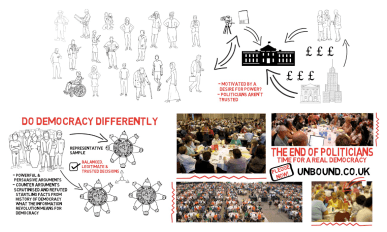
  • The idea: A new “compelling, inspiring” book on sortition, The End of Politicians, by director and co-founder of the Sortition Foundation, Brett Hennig, is being crowd-funded now by book publisher Unbound: https://unbound.co.uk/books/the-end-of-politicians

The-End-of-Politicians-screeenshot

  • The meeting: The first Sortition Foundation Annual General Meeting will be held at 6pm on Wednesday April 6th in central London. Venue to be confirmed depending on numbers, so please RSVP if you intend to come along.
  • The Strategy: A strategy meeting on how to progress the Citizens’ Parliament campaign (http://www.citizensparliament.uk/) will also be held on Wednesday April 6th from 1-4pm in central London. Exact venue will also depend on numbers, so please RSVP if you want to come along.

Read on for more details on all of the above.

Continue reading →

Irish senior coalition party wants more allotted bodies

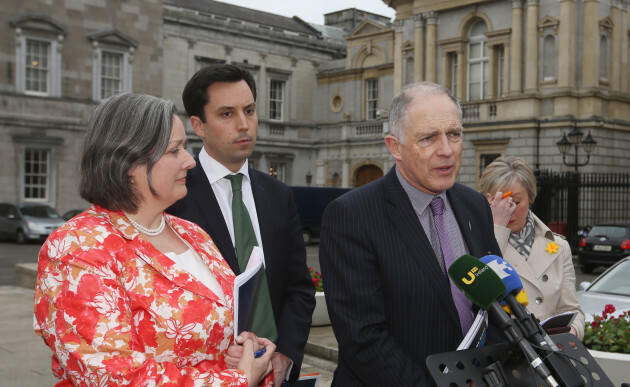
During a recent presentation of their party’s government reform plans, four parliament members from the Irish senior governing party Fine Gael said that “the party wants ’randomly selected’ members of the public to review issues like climate change, Seanad Reform and the Eighth Amendment”, thejournal.ie reports. The report adds:

Fine Gael has previously suggested the issue of the Eighth Amendment could be put to a public forum similar to the Constitutional Convention.

The party has expanded on that with its proposal for a ‘Citizens’ Assembly’ consisting of members of the public who could carry out a “detailed review of a limited number of key issues”.

Their findings would be referred to the appropriate Oireachtas Committee and then to the government.

Marcella Corcoran Kennedy TD insisted that the Citizens Assembly would not be a ‘talking shop’ that would put issues like abortion on the long finger: “Because it would be established by the Oireachtas, you could set specific timelines so there’s plenty of scope there to make the Oireachtas involved to a greater degree with the result of the discussions of the Citizen’s Assembly.”

On the issue of climate change, Corcoran Kennedy said that putting it to a Citizen’s Assembly would help make the issue “part of the dialogue of every citizen in this country”.

Why I am not a kleroterian

That is because I don’t think equality of power is the supreme objective or that sortition alone is sufficient to achieve it, or many other important objectives.

If we go back to my 1985 book, most of it was devoted to exploring many problems which have only tenuous links with sortition. All that other stuff was ignored, fair enough, and a group formed with “a passionate belief in sortition” as its bond. I, in the other hand have always emphasised that having good people in positions of power is not enough to ensure good outcomes. Everything depends on the procedures and processes by which those outcomes are produced. In particular, where collective decisions are arrived at by following certain procedures, the logic and dynamics of those procedures are just as important to the outcome as the input fed into them.

Moreover, I want to insist that while we can best understand the logic of such procedures, by studying simple models, the dynamics are always a matter of what works under what conditions and on what scale. For instance decision procedures depend on information flows, which depend on technologies of recording, storing, retrieving and circulating relevant information rapidly enough and in such quantities as the time available demands. What “ought to work” often doesn’t, as we all know.
Continue reading →

Norgrove: Why Britain Should Scrap Democracy in Favour of Sortition

Oliver Norgrove writes in The Huffington Post:

Horse-shoeing my way round the English coastline, setting up stools, handing out thousands of leaflets and talking to many passers-by certainly has come with its frustrations. As I wrote on my blog a few days ago, my patience for democracy and its input of all has now pretty much whittled away.

Without meaning to sound too contemptuous, I cannot bring myself to trust various sects of the population with a say on how the country is governed. Inevitably, polling day becomes Groundhog Day, in which the clueless, easily-manipulated and generationally tribal congregate like farm animals in a bid to shape the country’s government according to their own inaccurate, dogmatic or bigoted predispositions. […]

Problem is, of course, that nothing is preferable to democracy. Nothing beats the hot fury of election night, or the excitement of those voting for the same party they’ve always selected (rarely through genuine political passion and generally for the comfort of brave, tribal voting) and constantly wonder why things never seem to get any better.

Enter sortition.
Continue reading →

Beyond adversarial politics?

If you want to succeed in business, the basic thing that is needed is to offer a good product. So you must see to it that the various elements of your production and distribution teams work together to that end. If they fall into an internecine conflict in which each element is competing for power, the enterprise will fail.

Similarly, where a public good is concerned, success in getting a genuinely public good depends on focussing attention on the integrity of the good to be produced, not on the interests of the parties involved in designing it. I shall illustrate what I mean from an actual example, necessarily somewhat simplified. There is no lack of other instances.

Case study

Some years ago a consortium of developers (CD) proposed to build a n east-west tunnel under the Sydney CBD to relieve the city centre of traffic trying to bet from east to west or west to east, It was not to cost the State Government (SG) a cent, but the SG would use its power to acquire compulsorily any land needed, eg for entry and exit, and sell it at cost to the CD. The tolls they charged would reimburse the CD. Interested parties were invited to make submissions about how they were likely to be affected by the project. Perfect!
Continue reading →