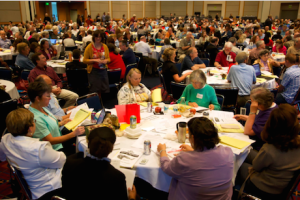
G1000 Kick Off in the UK – Cambridge, September 24th

against-elections.jpgIf Brexit proved anything, it proved that what Christopher Achen and Larry Bartels say in Democracy for Realists: Why Elections Do Not Produce Responsive Government is true. People do not vote after careful consideration of facts and options, they vote to affirm their membership of various social groups and express agreement with the opinions of those groups, which may have little or nothing to do with the issue at hand being voted upon.

As David Van Reybrouck expressed so eloquently in his article, Why elections are bad for democracy (an extract from his book Against Elections) there is something very wrong with voting and elections and there is a much better way to do democracy: select a representative random sample of ordinary people, provide them with balanced information, and let them deliberate together to find out not what people do think, but what they would think, if given the time and information together with a good deliberative process.

From 11am to 4pm on September 24th, in Cambridge at the Six Bells Pub, a group of volunteers will meet to kick-off the process of bringing Van Reybrouck’s brainchild – a G1000 – to the UK for the first time. The dream is to bring a randomly selected group of 1000 residents together for one day in early 2017, to deliberate and decide together what is best for Cambridge.

But we need your help to make it a reality. We need people to donate their time and their energy to help organise such an event. We will need fundraisers, social media ambassadors, technicians, volunteers, cooks and a whole host of other help. Can you be one of these people? If so please join us, get in touch or come along to the G1000 Kick-off in Cambridge on September 24th.

[This post is from the Sortition Foundation blog: http://www.sortitionfoundation.org/g1000_kick_off_in_the_uk_cambridge_september_24th]

More citizen juries in Australia

The newDemocracy foundation has recently been managing the citizen jury process in regards to the South Australia nuclear waste dump proposal. Now it has been hired to manage another citizen jury process – this time in Victoria:

Jay Weatherill has issued an “I told you so” over his oft-criticised Citizens’ Jury model, after it was adopted by the Victorian Government as it seeks to mop up in the wake of its dramatic sacking of the Geelong Council.


Sacked Geelong Mayor Darryn Lyons outside the Victorian Parliament.

The Government in April moved to dismiss the entire council – including colourful mayor and notorious former paparazzo Darryn Lyons and his deputy Bruce Harwood, the father-in-law of former Adelaide star Patrick Dangerfield – after an inquiry found it had become so dysfunctional and riven with internal conflict and a bullying culture that it could no longer govern properly.

Fresh elections won’t take place till October next year, with an administrator overseeing the region in the interim.

But Premier Daniel Andrews has announced the formation of a Citizens’ Jury to help set the parameters of an overhaul of the next council’s governance structure – to be overseen by Sydney-based newDemocracy Foundation, which selected the 50 jurors involved in this month’s Adelaide forum on the merits of a high-level nuclear waste dump.
Continue reading →

Democracy In Practice’s newest project

We are happy to announce the launch of our newest project focused on democratic experimentation and innovation in collaboration with the R.V. High School in Bolivia. Check out our launch video below, and stay tuned for more updates! Happy to hear any of your questions and comments.

Democracy In Practice


Sortition as a business opportunity

In Australia, sortition is a business opportunity:

Combining a shrewd business acumen with a philanthropic social conscience, the SA-based start-up – which formally launched last week – aims to work with governments, business, not-for profits and communities to broaden democratic engagement.

[…]

“It’s really nice to be able to set the boundaries of what’s authentic and inclusive, and what’s not … we’re really only interested in those (clients) that are actually sharing decision-making.”

Even before its official launch, the fledgling company has already made a splash; it managed the recent Citizens’ Jury process that reviewed policy prescriptions for the management of unwanted dogs and cats, and is now engaged with the Premier’s Taskforce on Healthy Kids’ Menus.

But both Lawson and Jenke are confident the long-term success of their venture isn’t predicated on political whim.
Continue reading →

Citizens’ assemblies are open to manipulation

Naomi has just flagged up an interesting article from Village Magazine on the Irish experiments with constitutional conventions in 2011 and 2016 by Eoin O’Malley, one of the participants. The article adds to my concerns that ‘full mandate’ allotted bodies are open to manipulation:

Some research shows that the act of deliberating with others has an impact beyond exposure to arguments or evidence. That is people given the evidence and arguments don’t move as much as those who are asked to discuss that evidence and arguments with others. This sounds like something positive for deliberative mini-publics. But it might not be.

The reason for this is because (as Condorcet demonstrated), independence is the key to getting the ‘right’ answer and this suggests that communication between jurors should not be encouraged — all that is needed is exposure to balanced arguments and evidence (as Goodin and Niemeyer discovered in their study of the Bloomfield Track citizens’ jury). This is distorted by the need to come to collaborative conclusions:

Because they are not independent the same flawed thinking or arguments can be magnified. For instance we could see the citizens in the mini-publics engage in groupthink. Some opinions might be aired, but can be effectively suppressed by the atmosphere in the room. There is significant evidence in social psychology that groups can push opinion to extremes and silence minority opinion. To prevent this great care has to be taken that all views are respected.

Continue reading →

Sortition is good for investor confidence

The Australian Broadcasting Corporation reports:

SA Nuclear dump debate to go before citizens’ juries

South Australia will randomly select 400 people to sit on citizens’ juries to consider the state’s approach to its nuclear future.

The juries are part of a public relations exercise Premier Jay Weatherill said would cost less than $1 million this financial year and there would be additional spending after that.

The announcement came a day after the Nuclear Fuel Cycle Royal Commission report said plans for a high-to-intermediate-level waste dump should be actively pursued, if the public wants it.

Mr Weatherill said it was important to have “the fullest and most mature debate that we can possibly organise”.
Continue reading →

Arash Abizadeh: Take electoral reform away from politicians and let citizens decide

David Schecter wrote to point out an article in the Canadian Globe and Mail by Arash Abizadeh, a professor of political science at McGill University:

Take electoral reform away from politicians and let citizens decide

Prime Minister Justin Trudeau campaigned on a promise to change the way we elect Parliament. Here’s the problem: letting politicians who won the last election decide future election rules is like letting the team who won the last playoff game decide rules for the next game. There’s an obvious conflict of interest. Electoral rules determine who forms government, and different rules favour different parties.

[…]

One solution is a referendum. But the Liberals have ruled this out. Maybe they’re right to do so. Referenda are expensive, few Canadians care much about electoral reform, and fewer still will cuddle up with a treatise on voting systems this Sunday evening. A referendum might be a big waste of money in which few vote and fewer still care to learn about the pros and cons of alternative electoral systems.

But without a referendum, how could electoral reform be legitimized? We need a manifestly fair procedure – a neutral body, unbeholden to politicians, that will reasonably evaluate the alternatives.

Fortunately, political scientists have a solution that fits the bill – a randomly selected citizen assembly. The idea is this: randomly select a few thousand Canadians, ask if they are willing to serve, and, from those saying yes, randomly select 100 to 200 to serve on an assembly empowered to determine federal election rules.
Continue reading →

Democratic Innovation on Postwaves

postwaves

Adam Cronkright writes:

This is Adam Cronkright, cofounder of Democracy In Practice, an organization that has been experimenting with random selection of representatives in student governments in Bolivia for the past two years. Independently from Democracy In Practice, I’m putting out a call for contributors and readers of Equality by Lot to participate in and help beta test a new online platform that randomly distributes decision-making/moderating power and responsibility among its users.

I’ve been doing some beta testing for a website called Postwaves. The site is inspired by the Wisdom of Crowds (popularized by James Surowiechi) and uses sortition to share moderator responsibilities evenly among all the members of a forum. That is, each post gets randomly and anonymously sent out to a small portion of forum users who vote independently and anonymously on whether the post is relevant to the large group (NOT on whether or not they agree with the post). If it receives a certain threshold (say 50% of those randomly asked to assess it find that it is relevant) it get’s made public on the forum. So in essence, they are testing a sortition-based, scalable way for online groups to moderate themselves horizontally. The idea is to more effectively filter out noise (i.e. irrelevant content) and allow the best content to be most visible regardless of who posted it (celebrity vs. normal person) or whether the first person(s) that read it gave it a thumbs up or a thumbs down (which can have a disproportionate effect on the opinions of those that follow).
Continue reading →

Now even the visa lottery is unsafe?

According to the NYT,

a small number of giant global outsourcing companies had flooded the [U.S. H1B visa lottery] system with applications, significantly increasing their chances of success. […O]ne of the outsourcing companies applied for at least 14,000.

What has happened to the ‘sanitizing’ effect of the lottery?

Does it matter that well-resourced companies ‘game’ this lottery?

[‘Outsourcing‘: A practice used by different companies to reduce costs by transferring portions of work to outside suppliers rather than completing it internally. (investopia) In the UK this practice is known as ‘sub-contracting’.]

newDemocracy Funding Will Allow Look Into the Way Communities Experience Democratic Innovation

Below is a release regarding an upcoming research project that focuses on the way that communities experience the shift from elections to randomly selected governance models, using Democracy In Practice’s work in Bolivia as a case study. Thought it might be of interest to the group!

A recent award of funding from the newDemocracy Foundation (nDF) will enable Democracy In Practice to conduct innovative empirical research into the way that communities experience change to their systems of government.

The research project, occurring under the auspices of Simon Fraser University in Canada and running from October 2015 to June 2016, will use Democracy In Practice’s student government-based projects as case studies to explore the shift from elected governments to those that are randomly selected and rotated. The research team will conduct empirical research to explore how various stakeholders – students, student government members, and teachers – experience and interpret the replacement of a hierarchical election-based student governance system with one based on random selection, rotation, and deliberation among equals. The projects that will be studied are now in their second year of operation in Cochabamba, Bolivia.

While the use of random selection to create more inclusive, representative and deliberative democracy has been a mainstay of democratic innovations around the globe, these innovations have largely been limited to temporary, one-off, complementary processes, and little is known about how these democratic structures would function as a standing feature of democratic governance. Research on the use of random selection in standing political bodies has to date been limited to theory, and so this empirical research project represents the first of its kind.
Continue reading →