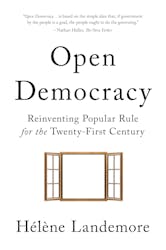
Landemore: Open Democracy, part 1

I have recently started reading Hélène Landemore’s book Open Democracy (2020, Princeton University Press). Having gone through the first two chapters, I find the book very useful and I highly recommend it. Despite its somewhat clichéd title, and despite the occasional bow toward the self-serving traditional Western theory of democracy, Landemore is in fact offering (it seems so far, I should say) a rather radical critique of the status quo and does not shy away from throwing some heavy punches at theorists who in one way or another defend oligarchical ideologies. In fact, Landemore presents – even if intermittently and obliquely – a thoroughgoing critique of the elections-based system that is not only better argued than, say, that of Van Reybrouck, but also more radical than his. I can’t think of a comparable book from a mainstream US political scientist. (Maybe Dahl’s A Preface to Political Theory?) The fact that Landemore, now at Yale, is originally French, may be playing a significant role.

Here is a first installment of my comments. I hope to have quite a few more posts discussing Open Demcoracy.

“Open Democracy”

To start: the title, “Open Democracy”. This does not bode well. Is there such a thing as a “closed democracy”? Is this making an implied assertion that our current system is a closed democracy, while we should be aiming at an open democracy? The term “open” has the odor of a buzzword (as in “open source”) – a feel good term which like “democracy” itself, or “people power”, could really mean anything.

On page 2 (I am reading the electronic version, so page numbers are approximate), when discussing what are supposedly historical examples of democracies, Landemore gives what seems like a definition of “open democracy”: a situation where “in theory”, any member of the political community “could access the center of power and participate in the various stages of decision-making. Citizens could literally walk into the public space to be given a chance to speak and be heard”. This is contrasted with the modern situation where “many have the feeling” of being “left out of the most important centers of political power, while the political personnel form an elite that is separate from them”.
Continue reading

Only two days left to vote!

The poll for the change to the subtitle of this blog ends on Tuesday, yet currently only .02% of the “electorate” have recorded their preferences. This might seem like a trivial matter, but it crucially affects the range and scope of the posts submitted. The blog was founded by Conall Boyle and others some ten years ago in order to discuss the work of those with an interest in lotteries for equal distribution and social justice — see for example Barbara Goodwin’s Justice by Lottery. However the blog soon became dominated by those (like Yoram and myself) exploring the political potential of sortition in reforming (or replacing) electoral democracy. This change of focus seems to meet the needs of most contributors and readers but it would be a tragedy if those working on other aspects of sortition felt excluded by an over-prescriptive sub-title. If you look at the book series Sortition and Public Policy you’ll see that around half of the titles are devoted to the non-political use of lot. And many theorists dealing with the political potential of sortition, for example Oliver Dowlen and Peter Stone are unpersuaded regarding the use of sortition for democratic representation (they focus more on the Blind Break as an arational prophylactic against factionalism). So it would be good if the new subtitle reflected the full range of interest in sortition. If you want to vote, just go to the Online Poll, look at the list of “candidates”, choose your preference(s) and post a comment, it’s that easy!

Wang Shaoguang and Yves Sintomer on sortition

A 2019 hour-long discussion on sortition at Shandong University with Wang Shaoguang and Yves Sintomer was recently published by its moderator, Daniel A. Bell.

This is a rather wide ranging discussion, and its lack of focus is somewhat of a flaw, in my opinion. Ideas on various matters are expressed. Many of those are well-hashed ideas, and the discussants are content to simply repeat them rather than examine them critically.

One idea that I think is relatively novel is briefly offered by Sintomer toward the end when Bell asks for proposals for applying sortition:

I would give the power to citizen juries randomly selected to judge politicians, when they are accused of misbehavior. Because I don’t trust other politicians to do this, as in Brazil or in the USA, where the impeachment is voted by the Congress. I think it’s a bad setting. And I don’t trust judges for judging politicians. Because judges are a very specific, professional body, and very often, a highly conservative body. I trust more randomly selected citizens to judge politicians when they are accused of misbehavior.

Varoufakis on democracy

An excerpt from a 2019 discussion between Yanis Varoufakis, the Greek economist and politician, leader of the MeRA25 party, and Caroline Lucas, the only Green Party UK MP.

CL: Your country is seen as the birthplace of democracy. In your opinion has there ever been a really good democracy we can look at and say, ‘That was when it was working well’?

YV: Democracy is always unfinished business. It is imperfect by design, especially in societies with vested interests vying for domination. But the merits of studying ancient Athenian democracy, which only lasted a few decades, is that it was the first and last time the poor controlled the government. Which is, interestingly, Aristotle’s definition of democracy. It was a remarkably radical idea that control over the instruments of the state should be independent of wealth.

CL: How did it work?

YV: Back in the times of the grand debates at the Pnyx, which was the parliamentary space in ancient Athens, there were two opposing parties: the Aristocrats and the Democrats. The Aristocrats hated democracy with a passion – but all the great philosophers we now eulogise like Aristotle and Plato were on the side of the Aristocrats. Nevertheless, the Aristocrats, who hated democracy, supported elections. And the Democrats did not.

CL: That sounds very paradoxical.

YV: The argument was that the Aristocrats could afford to buy influence in an election, so elections were an enemy of democracy. Democrats supported a lottery – sortition, as it is called today. Every official position in Athenian democracy was elected by lottery, including judges. Their terms were confined to six months. The only posts not sorted by lottery were the general, who had to know how to conduct a war, and bankers. The officials responsible for minting the money and for quality control of products like wine were slaves. Why? Because citizens had the right not to be beaten. Slaves did not. The idea was that bankers had to fear that they would be beaten up if they messed up the finances of the city. I think this is a splendid proposal for the City of London!
Continue reading

Sortition in 2020

Continuing the series of yearly reviews appearing on this blog every December since 2010, in this post I review the 2020 sortition-related events that appear to me most significant or interesting. I invite readers to add their own reviews in posts or comments.

The most prominent sortition-related development of 2020 was without a doubt the work of the French Citizen Climate Convention. This body of 150 allotted citizens started its work in back in 2019 and has published its report in June. It received significant media attention in France even before it published its report, but public attention has intensified over the last 6 months. In fact one commentator was alarmed that discussion of sortition in France has reached pandemic proportions.

In the face of the expected pushback from elite groups, the French public has shown significant support for the CCC itself and for its recommendations. Toward the end of the year warnings have been raised about what appears to be the government’s attempts to abandon or water-down the implementation of the Convention’s proposals. In late breaking news, Macron has indicated that he is aiming to put constitutional changes aligned with the Convention’s proposals up for a referendum.

The work of the CCC and the aftermath of its report received scant coverage in the English-speaking media (with the sole exception of Equality-by-Lot).

At the same time, sortition made more modest progress in other countries as well. It was implemented or discussed in multiple contexts in Germany: 1, 2, 3, 4. Sortition was also implemented or proposed in Switzerland, Belgium, Greece, the United States, and Scotland.

In the United States, sortition got some fairly high profile exposure by Malcolm Gladwell (1, 2). On three different occasions sortition was proposed by undergraduate students as a replacement for the electoral system. It was also proposed as a way to achieve citizen oversight over the police.

Finally, two sortition-related books of interest were published this year. One is a hefty report published by the OECD on “Innovative Citizen Participation”. The report makes a historical summary of hundreds of cases of citizen participation in government, draws its conclusions and makes recommendations. The second book is by notorious sortition activist Paul Rosenfeld. In stark contrast to the OECD publication, Rosenfeld’s book, a combination of an autobiography and a sortition manifesto, makes for an easy and entertaining afternoon read.

Claude Sicard: Replacing representative democracy with participative democracy is dangerous, Part 1

A translation of an article from Le Figaro.

Replacing representative democracy with participative democracy is dangerous
Claude Sicard, economist and international consultant
July 6, 2020

Seeing his popularity ratings decline, Emmanuel Macron appeals to the French people for a reform. For this economist, the head of state’s seemingly bright idea is a mistake because making decisions concerning the future of a country requires thorough study and the assistance of experts.

Macron at the Citizen Convention for the Climate at the Élysée, June 29, 2020.

The distance in our country between civil society and the institutions never stops increasing. In every democratic system it is the law that the majority prevails: the dominant fraction imposes its will on the minority, and the electoral moment is decisive for the duration of the mandate of the elected representatives. These principles are increasingly questioned these days. Minorities are increasingly unwilling not to be heard, and moreover they too often observe that the elected do not always have the virtues which they claimed to have during the campaign. Pierre Rosanvallon, a noted researcher of democracy, tells us that we are seeing in our modern democracies the rise of the “people as a judge”. The “monitoring citizen”, he says, is replacing the “voting citizen”. In this way a tendency has developed in our modern societies toward the creation of “counter-democracies”.

CEVIPOF surveys confirm this claim: 70% of the French think that in our country democracy “does not function very well”, and assert that they have no confidence in the ability of members of parliament to address issues that the country is facing. The American political scientist Yascha Mounk, a Harvard professor, writes in his book The People vs. Democracy published in 2018 that “in North America and in Western Europe, a growing number of citizens are turning their backs on democracy: they are feeling that they have less and less influence over political decisions”.
Continue reading

New edition of Down with Elections!

The latest edition of “Down with Elections! a plan for Democracy without Elections” is now available. The paperback is at https://www.amazon.com/DOWN-ELECTIONS-plan-DEMOCRACY-WITHOUT/dp/B0851M9H3F.

Users of this forum can obtain a free digital version (epub, mobi or PDF) directly from me (email to cwallace@free.fr).

Changes from the last published version (V3) are mainly explanatory, there are no major changes to the model of government proposed. (Changes from earlier versions are too numerous to list here.) Nothing I have seen or read recently has persuaded me that the overall design of the system proposed in the book needs changing, and events of the last few years – indeed of the last two hundred years – have only reinforced my opinion that we cannot have true democracy until we replace elected parliaments by ones chosen by lot.

Une version française est maintenant disponible (en broché) :
https://www.amazon.fr/démocratie-sans-élections-Campbell-Wallace/dp/B085R72PK5 (5,38 € + livraison)
ou
https://www.thebookedition.com/fr/democratie-sans-elections-p-372653.html (7,23€ + livraison)

On peut avoir la version digitale gratuitement en envoyant un mail à cwallace@free.fr.

Testart on democracy, democratic debate and citizen power, Part 2/2

This is the second part of a translation of a 2017 interview in Le Comptoir with Jacques Testart, a prominent French biologist, and long-time advocate for citizen power. The first part is here.

Le Comptoir: Citizen juries have so far been employed in a consultative role. Can you explain what those procedures are and within which frameworks they do they work?

Testart: The democratic procedures for citizen juries or assemblies are very vague. The principle is always to ask a group of allotted people to express their opinion on a certain problem. Citizen conferences, which are the most well-formed model, were invented by the Danish parliament in the 1980’s, perhaps because the Danish MPs are less conceited than ours. They noted that they were unqualified to politically manage technological and medical problems.
Continue reading

Democracy according to Richelet

The Richelet dictionary, edited by César-Pierre Richelet and first published in 1680, was one of the first dictionaries of the French language. The dictionary defines “Democracy” as follows:

Democratie: Gouvernement populaire. État populaire. Forme de gouvernement où les charges se donnent au sort.

Or, translated to English:

Democracy: Popular government. A popular state. A form of government where offices are distributed by lot.

(Thanks to Arturo Iniguez for noting this historical fact.)

The Potential of Weighted Sortition

This is the 5th post in a series on Barbara Goodwin’s classic work on sortition Justice by Lottery, University of Chicago Press, Chicago, 1992. Previously published parts: 1, 2, 3, 4.

Sortition is hiring without human intervention using random rather than reasoned criteria. Weighted sortition, though, is a statistical narrowing down of randomly chosen job candidates to the more ready among workers available. In Barbara Goodwin’s words, they are “lotteries where some people get extra chances of winning according to their personal characteristics or qualifications.” More broadly, the chances of “winning” a position can be micro-managed to take in any number of other factors beyond qualifications, such as need and desert, both personal and social, both present and future.

Goodwin’s “Justice by Lot” introduced to me the idea of weighted sortition. True, she dismisses it as “impure” compared to completely random sampling of the entire population, but the idea has intrigued me ever since I encountered it here. Admittedly, playing with percentages increases the complexity of choices, but complexity, in an age of supercomputers, data mining and artificial general intelligence (AGI), is not the obstacle it was even ten years ago. A weighted lottery allows for intriguing possibilities never imaginable before. It can factor into every hire whatever evidence-based social science deems well grounded, including experience, aptitude, personal choice and even broader social goals. The difficulty is that the advantages of sortition itself have to be clear to a broad proportion of the population before weighted sortition comes into play, as Goodwin points out,

Only by participation, which is a continuous process, would people acknowledge the authority of a social lottery [p. 71].

Continue reading