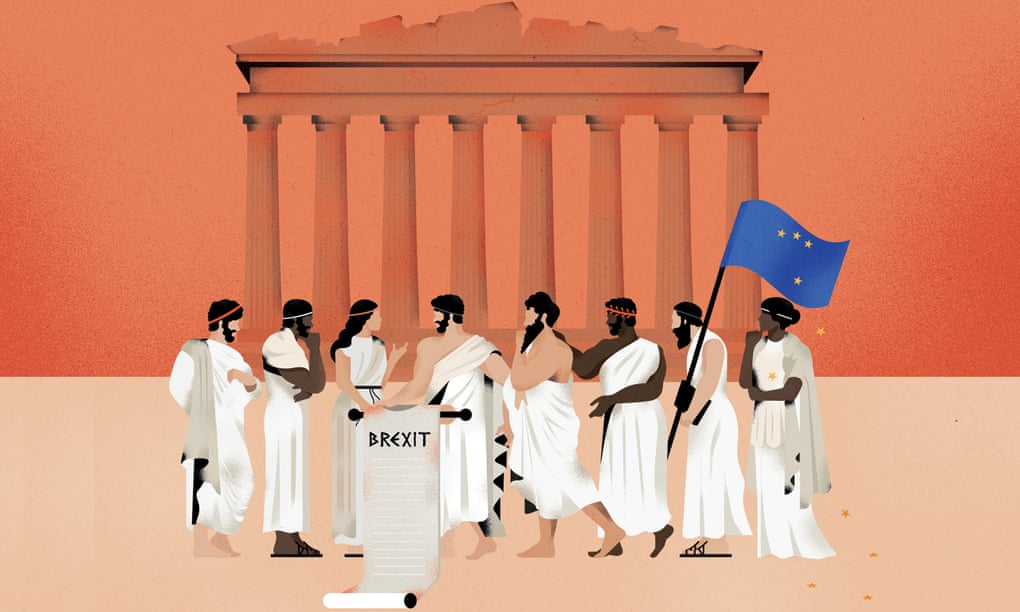
Upcoming event: Selina Thompson in conversation about sortition with Maddy Costa

An upcoming event in the Arnolfini arts house in Bristol.

Sortition: Selina Thompson in conversation with Maddy Costa
Saturday 03 November 2018, 18:30 to 20:00

Following a year of research and exploration, this is your chance to hear from artist Selina Thompson about the thoughts and ideas behind the development of the project Sortition.

The research included the hosting of a week-long Sortition boot camp with twelve young people from across the country here at Arnolfini, and an investigation into what Sortition might look like in both a gallery and theatrical context.

At this new event which is part of 14-18 NOW and its series Represent reflecting on the centenary of the first women gaining the right to vote, Selina Thompson takes some time with critical thinker Maddy Costa to reflect together on the future of democracy, and what the role of artists and the participatory contexts that they create might play in this.

Demarchy—small, sample electorates electing officials

From Cornucopia of Ideas, Social Inventions Journal for 2001, by Roger Knights, “Demarchy—small, sample electorates electing officials,” pages 237–44

[SIJ editor’s comment:] Sumarized from a longer paper by Roger Knights entitled ’Nec Pluribus Impar’ which can be read in full on the web (at www.globalideasbank.org/demarchy.html)

(Alas, it’s no longer available online because the Global Ideas Bank was hacked and destroyed. My own copy was lost due to one of Microsoft’s black screens of death.—Roger Knights)

I contend that if the power of electing officials were transferred to small, sample electorates, government would be more accountable to common sense. 

What’s wrong with current democracy is that it is too influenced by interest groups and crusading moralists. And where those two forces are in abeyance, it lacks common sense.

The theory of democracy is that the government should be accountable to the common sense of the community. Now, common sense is a quality, not a quantity; it is present to the same degree in a small sample of the electorate as it is in the whole body. This system of demarchy that I propose would make democracy more real.
Continue reading

Social Inventions Journal Extracts on Sortition

Here, for the sake of bibliographic completeness, are proposals for forms of sortition published in the Social Inventions Journal’s (SIJ), annual compilations from the Institute for Social Inventions, up until 2002, when it ceased publication.

Additional suggestions were posted to its website for several more years, until it was hacked and disabled, making it impossible for me to look through it. Its backup versions on the Wayback Machine do not allow one to see more than the first 25 or so entries under its “Politics” category. (I wish some charitable foundation would fund its restoration to archive status, at a minimum.)

From Re-Inventing Society, 1994, “Random selection of Lords,” by T.M. Arting Stoll, page 190

How about random selection from the population of people to serve one year in a Senate replacing the Lords?

From Best Ideas, 1995, “Voter juries, vetoes and feedback,” by Geof Mulgan and Andrew Adonis, page 245

[SIJ Editor’s note:] Adapted extract from an article by Geof Mulgan and Andrew Adonis in Lean Democracy, issue No. 3, £5, of a journal from the think tank Demos, 9 Bridewell Place, London EC4V 6AP (tel. 0171 353 4479, fax 0171 3534481; e-mail Demos@Demon.Co.UK>).

If democracy means self-government, it is doubtful whether Britain and other western countries should be called full democracies.

A critical democratic dimension, the personal involvement of citizens in government, has gone almost entirely neglected.

We have three moderate, specific proposals for change:

Voter juries [good term—RK]: the piloting, at the national and local level, of voter juries to assess the pros and cons of contested policy proposals. They would be established on a similar basis to judicial juries, but without formal constitutional authority.

Voter vetoes: The introduction of voter vetoes, giving citizens at national and local level the right to call consultive referenda on strongly contested legislation or council decisions. At national level one million citizens would need to sign a petition for a referendum to take place.

Voter feedback: Local experiments to engage people in deliberation on local issues of controversy using the combined television and telephone networks being built by cable companies in conurbations, in collaboration with local authorities and other local institutions.

From Creative Speculations, 1997, “Citizen juries for considering policy options,” by the Institute for Public Policy Research, pages 234–36
Continue reading

Hannah Arendt Center’s Bard Institute for the Revival of Democracy Through Sortition

The Hannah Arendt Center for Politics and Humanities at Bard College is introducing the Bard Institute for the Revival of Democracy through Sortition:

Introducing the Bard Institute for the Revival of Democracy through Sortition

True Democracy as Practiced by the Ancient Greeks

“The appointment of magistrates by lot is thought to be democratic and the election of them oligarchic.” —Aristotle, Ancient

Sortition (noun) – The action of selecting or determining something by the casting or drawing of lots.

The Bard Institute for the Revival of Democracy through Sortition is conceived as a critical platform to assemble the diverse research and resources that are emerging around deliberative democracy and sortition. We are a project of the Hannah Arendt Center at Bard College, and place much importance in the association with her legacy of thought. We believe sortition satisfies Hannah Arendt’s ideal of political freedom and that it would have figured in her writing, had it not been buried in the history books. As investigators of the practical possibilities of this ancient and reviving model of democratic decision-making, we are based in Germany, the United States, and wherever else our research may take us.

The Institute was cofounded by recent Bard College graduates Jonas Kunz and Hans Kern. Check back with us soon for updated content, links to sortition in the news, and much more. Sign up by email to receive updates on the Institute’s activities.

“Demiocracy”—a Nifty Neologism

We need a term that parallels “democracy”: one that names a system of government in one word. Demiocracy and its cognates (Demiocrat & Demiocratic) do this.

Moreover, Demiocracy is not an unduly puzzling new word: it immediately communicates:

1) That it’s a variant of democracy (only an “i” has been added), and

2) That it’s something small (a “demi-democracy”), from the prefix “demi,” whose dictionary definition is “half, semi, partial.” (The last item, “partial,” fits Demiocracy best.) (Demiocracy and its cognates should always be capitalized, so readers realize it’s not the word “democracy” (which is ordinarily lower-cased).)

Terms like “citizens jury” and “citizens assembly” are useful in places, but: 1) They lack cognates. 2) They are more descriptive than “Demiocracy,” but they aren’t adequately descriptive. A person encountering those terms might wonder, “Don’t we already have juries made up of citizens?” or “Don’t we already have town meetings?” Most importantly, 3) they fail to suggest the vital ingredient of diminution (via sampling), which “demi” does.

  1. Other terms lacking cognates are allotment and demarchy, although they can be used where appropriate.
  2. These terms do have cognates, but are obvious non-starters: lottocracy, stochocracy, and klerocracy.
  3. Sortition has cognates in sortitionism and sortitionistic, but those words lack the common touch. They’re my second choice—or maybe my third, after juristocracy. (I like “Sortinista” for a proponent of sortitionism.) It’s not perfect—but what is? It’s better than the alternatives, all things considered.

Here are other terms that can usefully employ the “demi” prefix and thereby mesh with Demiocracy:

Demi-public and Demi-jury: A citizens jury of one of the three types below; a body of lot-winners (regardless off the details of the lottery), used in place of Dahl’s term, “mini-public.”

  1. Demi-advisory panel: A Demi-public with advisory powers only. (Abbreviated as “Demi-AP”.)
  2. Demi-electorate: A Demi-public with electoral powers—i.e.,  to elect one or more office-holders. It might also have advisory powers.
  3. Demi-assembly (or Demi-Conclave): A Demi-public with the power to pass legislation—though perhaps only on to another legislative chamber, or on a specific topic or resolution. It might also have advisory and/or electoral powers.

Members of the above bodies would be called Demi-jurors, Demi-advisors, Demi-electors, and Demi-assemblymen / Demi-assemblywomen.

Demi-dubbing: The process of selecting a citizen to serve on a Demi-jury by some randomization process. The person so selected has been “dubbed” and he/she is a Demi-winner or Dubbee (i.e., dubbed by “the fickle finger of fate”).

Venice and Why Sortition is Not Enough

Without much commentary, given the high level of knowledge and debate on this blog, I share an important document about elections in Ancient Venice. As most here will know, I hold it that ‘pure’ sortition is a suitable and necessary tool for democracy. However, it is also an insufficient one, as has been criticised already at the time of sortition’s outset, with the powerful “Socratic Objection” as documented by Xenophon. Today, I describe the missing element specifically for appointments to positions of power.

As most here will know, the Ancient Venetians combined sortition with elections in multiple iterations to determine their leadership, the Doge. Their success with this add-on innovation was superior to the Athenians, as evidenced by the significantly longer duration of their system. Now, there clearly were flaws, room for improvement, as their system ended by reversal to today’s unfortunate party system but that’s for another day.

So far, most scientific papers on this topic have been descriptive. Now Miranda Mowbray, and Dieter Gollmann of the Enterprise Systems and Storage Laboratory at
HP Bristol expand the debate with this paper on the mathematical properties of the Venetian method in avoiding usurpation of power while still finding the best leadership. The authors have their mind on applications in distributed computing security, but for us here, the advantages for a more mundane topic such as democracy may be good enough to give it some thought.

Enjoy.

As an aside, the statutes of G!LT in Austria therefore employ the Venetian model for all executive leadership elections. My rationale is that the party system with its unholy alliance with mass media rewards showmanship and superficiality, as evidenced by the high proportion of TV Actors and Reality Show Stars in top jobs. Instead G!LT’s protocol ensures a reasonably self-experienced, direct, personal knowledge of a candidate’s ability and suitability for an executive position. For those who read German, here to the Statutes of G!LT. For those who don’t there is Google Translate.

Tim Dunlop: It’s time to replace voting with sortition

In 2014 Tim Dunlop had just been introduced to the idea of sortition by David Van Reybrouck. He was “not completely convinced by his [Van Reybrouck’s] argument, but [was] sufficiently incensed by our current parliamentary democracy and its many failures to at least consider what he suggests.”

Four years later, Dunlop has written a book advocating sortition, and has an article in the Guardian that opens with an unambiguous statement:

If we want to fix the way our governments work, the first thing we should do is replace voting with sortition in at least some of our governing bodies.

Like many feel-good reformists, Dunlop puts much emphasis on the potential for fostering deliberation, trust and respect amongst the members of the allotted chamber and by extension, in the population at large. However, bucking the norm among such reformists (including Van Reybrouck), Dunlop’s message is very clearly democratic in the most fundamental sense (i.e., making power representative) and his rejection of elections and its elitist implications is uncompromising.

If we are really serious about bottom-up reform of our democratic institutions, then reforming the seat of government itself in this way, a way that installs ordinary people at the heart of power, is essential. Our neoliberal economy and the representative form of government that dominates our societies do everything they can to divide us from and pit us against each other. A People’s House transcends these divisions and brings us together. The basic concept of sortition is pretty straight-forward, and introducing it as a replacement for voting in, say, the Australian Senate, while leaving that body’s other powers intact, represents, at least administratively, fairly minimalist change. But on every other level, the potential effect is explosive. In one fell swoop, you diminish the power of the parties and that of many of the lobbyists who exist to influence their decisions. You transform the way in which the media covers politics. You hand control of at least part of the legislative process to a genuinely representative sample of the population as whole, rather than vesting it in a bunch of elites and their representatives. You empower people in a way that the current system could never hope to do, and you reconnect our chief democratic institution with the life in common.

Nothing is going to change until the main source of power in our society, our seat of government, is populated by people who are genuinely representative of the society at large. We have been taught forever that the way to do that is by voting, but that is simply wrong, and the quicker we unlearn it the better, no matter how counterintuitive it might seem at first. If you want a truly representative government of, by and for the people, then you need to choose it not by voting, but by sortition.

1768: Scheme of a Political Lottery, for the Peace of the Kingdom

The following letter to the Political Register and Impartial Review of New Books, printed in London in 1768, offers sortition of parliament as a way to remedy the corruption of elections. Thanks to Terry Bouricius for drawing attention to this historical piece.

Scheme of a Political Lottery, for the Peace of the Kingdom

It is proposed, on or soon after the breaking up of the present parliament, to open a lottery of 2262 tickets at 1000l. each, three blanks to one prize; which prize shall entitle the possessor to a seat in parliament for the place therein mentioned: by which scheme the noisy and expensive business of electioneering (which puts the whole kingdom in ferment) will be over in two hours, many people have an opportunity of serving their country cheap, and much bribary and corruption be prevented.

The the produce (deducting five per cent. to be set apart for guzzle, and to be equally distributed in every borough) be applied towards paying the national debt. That the lottery be drawn in the court of requests, on the day appointed for the meeting of p——t, and that the members so elected do immediately adjourn to the house of commons, appoint a speaker, &c. and then proceed to business. This will effectually prevent all designs of bad ministers, and more especially if their tools should draw blanks, as no person can have more than one ticket, and that not transferable; lest the courtiers, nabobs, or adventurers, should engrose the whole and buy and sell the nation.

Sortinista Experts: Be a Guest on Talk Radio

To spread our “mini,” or “demi,” message, I urge notable advocates of citizen juries to appear on one or more of America’s numerous talk-radio shows. (These are probably rarer in other countries.)

I Googled for “talk radio guest application” and dozens of places or ways to apply came up; if you Google for that phrase, you will get them too. (I wasn’t able to capture the results-page’s URL and post it here for you to click.)

A four-hour show that usually gives guests a two-hour segment (40 minutes per hour—the rest is news and ads) is “Coast to Coast AM.” It has a large audience—about three million. It often has guests from the UK and Australia. It specializes in heterodox topics (including a fair amount of “woo”). Its downside is its late-night hours: 1 to 5 AM in the East; 10PM to 2AM on the Pacific coast. Here’s its website: https://www.coasttocoastam.com. Here’s its request for guests, on its “Contact” thread:

Be Our Guest

Have you ever wondered how to become a guest on Coast to Coast AM? It’s easy. Just send an e-mail to the Producer stating your name, phone number, the area of your expertise or the nature of your experience. If it sounds like something worth talking about on Coast to Coast AM, the producer will call you. It’s that easy. Write to: CoastProducer@aol.com

The most desirable guests on any show, I suspect, would have one or more of these qualifications, among others: An academic post; a publishing record; a speaking-to-audiences record; a good speaking voice and a smooth presentation; a “common touch,” a lengthy period in the field, … I think it would be best if two or even three guests appeared, for the sake of variety and balance, so maybe you should have a name or two to suggest as your sparring partner.
Continue reading

Sortition advocate arrested for allegedly planning to blow himself up on election day

On October 10th, various news outlets have reported that the FBI has arrested Paul Rosenfeld in NY, USA for allegedly planning to blow himself up with the goal of drawing public attention to the idea of sortition. The New York Daily News writes:

Rockland County man arrested for building 200-pound bomb, plotting to detonate it in DC on election day

A Rockland County man who cops say built a 200-pound bomb he was planning to explode in Washington, D.C., in an Election Day suicide attack was arrested Wednesday.

Paul Rosenfeld, 56, of Tappan, was busted on federal charges of manufacturing an explosive device.

“As alleged, Paul M. Rosenfeld concocted a twisted plan to draw attention to his political ideology by killing himself on the National Mall in Washington, D.C. — risking harm to many others in the process,” U.S. Attorney Geoffrey S. Berman said.

“Rosenfeld’s alleged plan for an Election Day detonation cut against our democratic principles.”

NBC News write:

New York man wanted to blow himself up on the National Mall on Election Day

Paul Rosenfeld was arrested on charges that he built a bomb and planned to kill himself with it to draw attention to beliefs in ancient election system.

The FBI has arrested an upstate New York man accused of building a bomb that he intended to use to blow himself up on the National Mall in Washington, D.C. on Election Day, authorities said Wednesday.

Court documents say Paul Rosenfeld, 56, of Tappan, wanted to draw attention to his belief in “sortition,” the ancient practice of randomly selecting legislators out of a pool of eligible voters.

The press release by the U.S. Department of Justice is here.

In 2015 Paul Rosenfeld has published an essay on Equality by Lot titled “The Extinction of Politics“. The article has been linked to by some of the reports of the arrest.