The Times alarmed about the radical proposals of the Sortition Foundation

The Times writes:

Group that wants to abolish MPs wins government cash

Even Extinction Rebellion believes the Sortition Foundation’s ideas are too radical

The taxpayer has been funding a group that campaigns for the end of parliamentary democracy and which even Extinction Rebellion considers to be too radical.

The Sortition Foundation has provided recruitment services for parliament and other governmental bodies, helping them to organise “citizens’ assemblies” that are used to inform decision makers on issues such as climate change.

Participants are paid to take part and chosen through a process of “stratified random selection” so that assemblies, made up of between 20 to 200 people, are representative of communities in the UK and can be used to guide government policy.

The not-for-profit company was awarded £26,000 by the Department for Environment, was among the beneficiaries of a £120,000 contract from the House of Commons and received £10,000.

Electoral body members selected via sortition in Mexico

A sortition procedure was used in Mexico to select the president and three council members of the Mexican National Electoral Institute, reports Mexico News Daily:

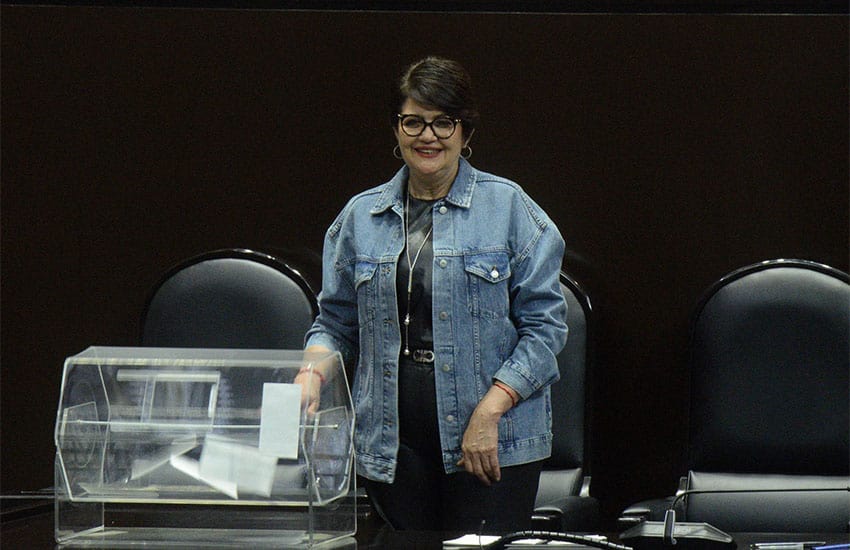
[Guadalupe Taddei Zavala] will replace Lorenzo Córdova at the helm of Mexico’s electoral agency next week after her name was drawn out of a transparent lottery box in the Chamber of Deputies in the early hours of Friday morning.

If that sounds like an unusual way to appoint the country’s electoral chief, that’s because it is.

Party leaders decided to use sortition – also known as selection by lottery and selection by lot – to elect the new INE president and three new electoral councilors since none of the candidates had the support of the required two-thirds of lawmakers in the lower house of Congress.

An agreement between the parties that would have allowed that level of support for four consensus candidates never materialized. As a result, sortition was used to elect an INE president and councilors for the first time.

The Morena party, which along with its allies has a simple majority in the Chamber of Deputies, were likely happy to resort to drawing lots because the majority of the 20 candidates for the four positions – all of whom were nominated by a “technical committee” earlier this month – are close to their party, the newspaper El País reported.

A democratic rock bottom

Guillaume Drago, a law professor at Université Panthéon-Assas Paris II writes [original in French] the following in the Catholic monthly journal La Nef.

A democratic rock bottom

It is the time, it seems, of “participative democracy”, which has been described as “the collection of methods aiming to involve the citizens in the process of political decision making” [L. Blondiaux, on the site vie-publique.fr], and which could be defined as the direct participation of citizens in the creation of rules, and in particular legislation. It surely involves that when it concerns the “Citizen Conventions” for the climate and for the end-of-life question.

The composition of these “conventions” is the product of allotment which is supposed to be representative of the French population. The institution which organizes these conventions is the Economic, Social and Environmental Council (CESE, pronounced “se-zeh”), with a “governance committee” which, it is easily understood, is there to steer the discussions in the desired directions and an “oversight body”, for the end-of-life convention [The role of the oversight body is defined on the site of the “convention”: “The oversight body is tasked with ensuring respect for the essential principles of the Citizen Convention: sincerity, equality, transparency, respect for the speech of the citizens. The body also verify that the conditions guarantee the independence of the Citizen Convention”.] The assessment of a legal scholar of the use of “citizen conventions” cannot avoid being severely negative, for several reasons.

The first is that these bodies are neither constitutionally nor legally recognized. No provision of our constitution discusses such a device for preparing or for participating in deciding laws or regulations. The law is silent on this type of device and it is unclear why the members of parliament would wish to give up some of their legislative power in favor of the citizens whereas those citizens have duly elected the members of parliament in order to represent them… For those two “conventions”, a simple letter of the prime minister to the president of the CESE is all that justifies their existence. They are then associated with what one of the sites of the “conventions” calls the “third Assembly of the Republic, and a legitimate player acting as an independent constitutional assembly, whose task is to be a juncture of citizen participation”. Good heavens! Such responsibility!
Continue reading

Letter to President Zelenskyy

Mr. Volodymyr Zelenskyy
President of Ukraine
11 Bankova St. 01220 Kyiv, Ukraine

Re: A proposal to fight corruption with local citizen assemblies

Dear President Zelenskyy:

First, thank you for your remarkable leadership. I wish you all the best in defending, restoring and advancing the well-being of Ukraine and its brave people.

I am writing with a suggestion that, if adopted, has the potential to advance Ukraine as a leading innovator in democratic governance. The proposal would also counteract the criticisms of American politicians who question ongoing funding for your nation — often citing government corruption as one of the justifications for curbing that support.

Perhaps you are aware of growing European interest in “citizens’ assemblies” whose members are chosen by sortition, a democratic lottery process, rather than by election. Ireland, for example, has successfully used citizen assemblies to resolve some of its most politically divisive issues: abortion, same-sex marriage, climate change. Two of Belgium’s regional parliaments (German-speaking Ostbelgien and the Brussels-Capital region) have established permanent sortition-selected citizens’ assemblies to counterbalance the power of professional politicians in the elected assemblies.

Continue reading

Using sortition to select Board Directors

Democracy Without Elections uses sortition to select all directors of its governing board since the beginning, December 2020. Are there any other boards that exclusively use sortition? Is sortition used to choose members of governing bodies in nonprofits, education or business anywhere else? Are there examples of using sortition to select some members?

Hugh Pope on the Belgian Citizens’ Dialogue

Hugh Pope has a piece in the The New European about the permanent allotted body in the German speaking community in Belgium.

If we are trying to fix our “broken politics”, is the solution really just another set of politicians? If the electoral system is at fault, might the process of government work better if it were run by a group of randomly selected citizens?

Liesa Scholzen is a politician whose constituents are the 70,000 German speakers on Belgium’s eastern border. People with an interest in new political systems are paying close attention to Scholzen’s hilltop parliament in Eupen, Ostbelgien. That’s because in 2021, as part of its Citizens’ Dialogue initiative, Ostbelgien inaugurated the world’s first official, permanent legislative body chosen not by votes, but by lottery.

“The Citizens’ Dialogue” […] is led by a standing council of citizens, drawn by lot. The 24-member council serves for 18 months, and they choose the topics which are then debated by separate Citizens’ Assemblies. These assemblies have 25-50 members, also chosen by lot, who make their recommendations following two to three days of deliberation. Members meet in the evening or at weekends, and receive expenses plus €50 to €95 (£44-£84) per session. All participants are chosen from the German-speaking community.

An interesting paragraph discusses the matter of the rate of acceptance:

[O]nly 5% to 10% of invitations to attend Citizens’ Assemblies are initially accepted. This is because people have no knowledge of them, no time to spare or just think the invitation letters are a hoax. Organisers usually ensure that those who do volunteer are representative through “stratification”, a second layer of random selection that balances gender, language, age, education and other criteria. But [activist Juliane] Baruck from Es geht LOS [a German organization promoting sortition] goes out knocking on the doors of those who don’t respond. “We trust the lottery to get a truly representative sample, so we keep trying,” she said. “I don’t try to convince those chosen. I ask them: ‘What do you need to join in?’ Already, we’ve got the positive response rate up to 22%.”

Continue reading

Bailly: The democratic quality of European Citizens’ panels

“The democratic quality of European Citizens’ panels” is an interesting study of the citizen panels convened within the framework of the Conference on the Future of Europe which took place in 2021. The study by Jessy Bailly involved interviews with dozens of participants in the panels.

The study highlights some of the problems of the lack of an acceptable design, resulting in biased outcomes. Examples of problematic aspects of the design are the use of volunteers, the way the experts are appointed, the overrepresentation of a stratum of their choice (youth in this case), and the lack of transparency of the sortition method.

Some excerpts:

When I surveyed the citizens, many praised the “diversity of people” within the panels. Others emphasised the lack of representativeness of the citizens’ panels, with at least 5 of the 31 citizens interviewed insisting on it. One of them was a German citizen in her 30s: “You should pay attention to a greater diversity of people and not only people who are pro-Europe. There should be a greater selection of different people, different social classes and also religions.” It is worth noting that the “social class” criterion had to be respected (through the prism of occupation). However, no ethnic or religious criteria were considered.

Continue reading

Oligarchical intents

A piece by Eva Talmadge in The Guardian presents its audience with idea of sortition. To what extent such an article covers new ground for the reader would be interesting to try and find out. The article itself links to a 2018 Guardian article proposing a Brexit citizen assembly.

The article quotes some of the usual sortition suspects – Claudia Chwalisz, Peter MacLeod, and Peter Stone, and presents the standard deliberative rhetoric around citizen assemblies about how people are more informed and reasonable when they deliberate and about the potential of citizen assemblies “to help fractured societies not only work on complicated problems, but learn how to live with one another”.

Sandwiched in, however, Chwalisz does contribute a quite subversive idea:

As the ancient Greeks and others recognized, elections are a way of constituting an oligarchy. When the French and American revolutions led to the establishment of the institutions that today we call democratic, the word ‘democracy’ was never used – the intent was for them to be oligarchic, concentrating power in the hands of the few.

Continue reading

Martin Wolf on Democratic Capitalism (and me as it turns out!)

Martin Wolf is talking up a storm on the crisis of democratic capitalism, and he’s supporting sortition as you can hear from around 11 minutes in where I’ve set it up to begin.

In case you’re interested, here’s the presentation he gave before the panel session recorded above.

Hugh Pope reports on the French citizens’ assembly on assisted dying

Hugh Pope writes in buergerrat.de on his impressions of the French citizens’ assembly on assisted dying. Below are some excerpts from the piece, with a few of my comments.

On 9 December, France embarked on [an attempt] to find answers to fraught questions around its ban on assisted suicide. As the centre of a national debate on the issue, it convened 185 people, randomly selected from all over the country and its overseas territories, to research, discuss and propose answers to the question: “Is the framework for end-of-life support suited to all situations or should changes be introduced?”

The assembly will convene for nine 3-day weekends over 4 months.

“You are here in a place in which new forms of democracy are being invented and developed … and of them the Citizen Convention is without doubt the most ambitious, the most demanding and the most engaging,” participants were told by [the president of CESE, the convening body], Thierry Beaudet. “It’s impossible to do this [deliberation] on the scale of a country, so you’re going to do it for us, for the whole of society … This is the basis of both your legitimacy and our trust in you.”

The randomly selected audience hardly looked revolutionary. Participants had only some of the youth and diversity of, say, the crowds travelling in the nearby Paris metro; they also had very few of the confident smiles and neat, conservative clothes that are the hallmark of elected politicians. At the same time, every element of society and France’s geography seemed present: a cheese farmer from the Alps, a professor of Greek and a retired teacher from Lille were joined by an immigrant from Niger, people of Algerian and Moroccan heritage and women in Muslim headscarves.

True mirror of a country’s whole population

It was unique to see a true mirror of a country’s whole population in one place: France came across as predominantly middle-aged, paler-skinned, polite, attentive and – after some initial shyness – articulate, collaborative and ready to challenge authority.
Continue reading