Much of the sortition discussion revolves around the legislative branch, but historically, it was often the random selection of magistrates that signaled a true democracy. I would like to start a discussion of how executive officers can be selected by lot in a modern state. This is crucially important, because while the legislature may be the traditional home of sovereignty in a democracy, the executive branch is what most citizens experience as the state.
My first post deals with a structure that I call a coordination hierarchy, which I believe should be the standard way to organize the political layer of the executive branch. In future posts, I will discuss criticisms and challenges to this structure, as well as fleshing out some other requirements to make this system work in practice. My ultimate goal is to describe a way in which the political layer can be populated by a political service: a professional corps of public servants who are responsive to the public through citizen juries, but which operates under a set of constraints that make it look more like the civil service.
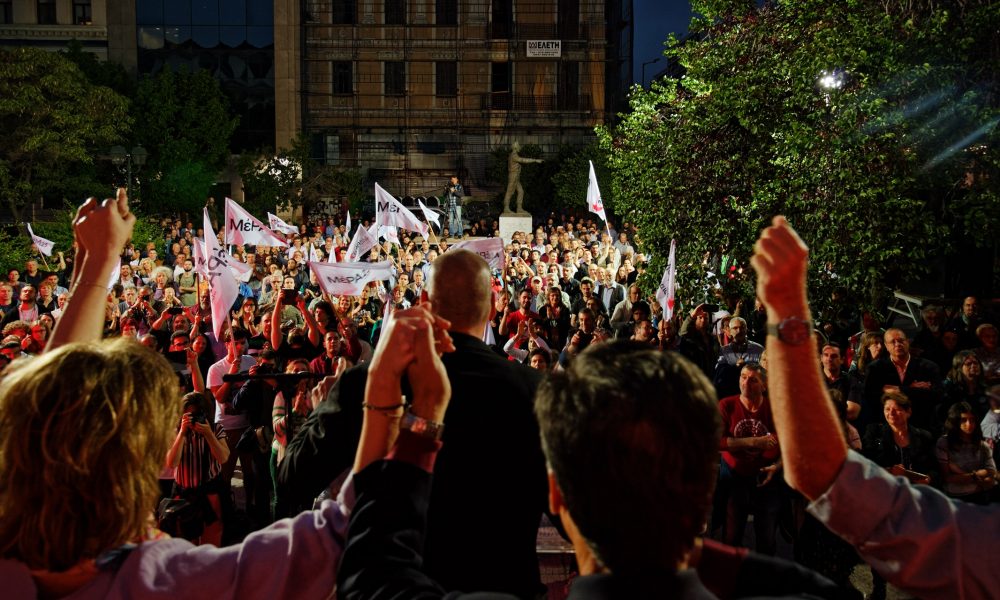
MeRA25 is a Greek party headed by former Syriza finance minister Yanis Varoufakis. MeRA25 has recently made two moves pushing sortition forward in the Greek political agenda.
Establishment of a new, autonomous General Secretariat for Public Revenue, whose General Secretary will be selected by neither the government nor the lenders. Instead, they will be elected by a Social Committe for Selection of Senior Personnel, 1/3 of which is comprised of parliamentarians, 1/3 by judges selected by sortition and 1/3 by tax professionals – accountants selected by sortition.
Secondly, MeRA25 is selecting its own central committee members with some of them selected by election, some by appointment and some by sortition:
The 1st Central Committee is comprised of the members of the current Extended Political Secretariat, 15 members chosen by sortition amongst all MeRA25 members (who are also DiEM25 members), 2 members from every Administrative Region (excluding Attica) put forward by the Secretary in concert with the Committee for the Organisation of the Congress and Movement Outreach, and 1 member from every electoral district, selected by the members of that district through e-voting.
The Women’s Party: An opening manifesto Aug 2, 2020
The case for an all-women party becomes all the more urgent seeing as the women’s reservation bill has been hanging fire for 12 years and at the panchayati raj level, where 33 per cent reservation has been implemented, many of the elected are being seen as stooges of their husbands, or worse, more malevolent forms of patriarchy.
Clearly, whether equity of outcome or equality of opportunity is the goal, reservations are not the final answer.
Say, we form a women’s party. Luck (sortition), and not election experience or ‘winnability’, will be the criterion for handing out tickets within this women’s party (it will perhaps make for grooming of many good leaders and save it from the trap a certain young Delhi-based, and now Delhi-confined, party has fallen into).
Turncoats may avail party membership but will be barred from this draw of lots. The left/right nature of electoral politics excludes perspectives and concerns falling outside particular party agendas — these are deliberately kept out for fear of misperception of ideological dilution on the part of the electorate.
One advantage of sortition over intra-party elections will be that, not being partisan in the old sense of the word, new members will bring to the table many more of these perspectives and concerns.
Scrap attempts to reforming politics as a whole. From a practical point of view attempts to do so by legal constitutional change have no possibility of succeeding from a theoretical point of view, it is folly to assume that if we agree broadly about principle and are motivated to act we will reach a practical agreement. As soon as you analyse the range of possibilities that emerge once one envisages ways of putting all those abstract principles into practice, the more one runs into a host of incompatible proposals.
IIUC, Burnheim argues that the political system either fails to recognize “known and recognised needs” or fails to recognize that established policy does not address those needs. Bodies that are supposed to recognize and address the needs “operate primarily in the interests of those who have power […] rather than the public interest”.
My view is that while it’s no panacea, [there] is likely to be a very effective role for specialised committees of citizens chosen by sortition. I also think that sortition for very specialised tasks is the way forward for many public activities. Don’t concentrate on what juries can’t do, but on instances where they are likely to do something useful.
Gruen:
There are three ‘poles’ of democracy. Direct democracy is one way to do democracy – but it’s both impractical and ill-advised even as an ideal in my view. This leaves representative democracy and I can think of two very different ways of selecting representatives. Competitively through elections and via sortition.
My entire program revolves around finding whatever ways might be possible to inject the latter into a system dominated by the former – whether those ways are large or small. Continue reading →
This is the second part of a translation of a 2017 interview in Le Comptoir with Jacques Testart, a prominent French biologist, and long-time advocate for citizen power. The first part is here.
Le Comptoir: Citizen juries have so far been employed in a consultative role. Can you explain what those procedures are and within which frameworks they do they work?
Testart: The democratic procedures for citizen juries or assemblies are very vague. The principle is always to ask a group of allotted people to express their opinion on a certain problem. Citizen conferences, which are the most well-formed model, were invented by the Danish parliament in the 1980’s, perhaps because the Danish MPs are less conceited than ours. They noted that they were unqualified to politically manage technological and medical problems. Continue reading →
In a new article in Dissident Voice I explain how laws can be decided by legislative juries, and why this is far preferable to laws being decided by elected politicians and the ballot initiative. This is an update and further statement of the legislative juries proposal I first published in 1998. I set out four ways in which I am in favour of laws being proposed to legislative juries, my preferred approach to deciding the details and arrangements for jury lawmaking, and some of the role agenda juries can play.
It would be far better and far more democratic if laws are decided by legislative juries rather than by elected politicians.
Legislative juries would decide proposed laws by majority vote, using secret ballot, after a fair hearing on a level playing field with supporters and opponents of the proposed law having equal time to present their case to the jury.
It is essential that rule by the people be exercised in an informed manner, including with regard to deciding laws, because informed views are a far better basis for a decision than poorly informed and uninformed views.
In the context of the recent mass outrage over the murder of George Floyd by a policeman in Minneapolis, Olúfẹ́mi O. Táíwò of the Pan-African Community Action reiterates the proposal made by Max Rameau to enforce citizen control over police via allotted citizen boards.
The core problem with policing and incarceration is the same problem that plagues our whole political system: elite capture. The laws, the regulations, the bailouts, and the wonks who write and evaluate all of the above are all powerfully influenced—if not functionally controlled—by elite political and corporate interests. We cannot put our faith in elected representatives and merely vote our way out of this problem: elections are more dominated by dollars than ever, and grassroots energy around political figures is increasingly shaped by identity politics, which faces its own elite capture problem.
Instead, we need to give power back to the people—directly. Under one specific proposal, offered by the Washington, D.C.–area group Pan-African Community Action (of which I’m a member), communities would be divided into districts, each of which would be empowered to self-determine how to maintain public order. Each district would hold a plebiscite to decide what to do with its current police department, immediately giving the community the direct voting power to abolish, restructure, downsize, or otherwise reconstruct their departments. Continue reading →
Florent Gougou and Simon Persico write in La Vie des idées about the approaching culmination of the French citizen convention on the climate and how its work should be translated into policy. They find the use of a referendum particularly appealing. Also included in the article is the useful chart above comparing along several dimensions the makeup of the French National Assembly to that of members of the convention (which were selected to reflect the makeup of the French population).
Deciding together: The citizen convention on the climate and the democratic challenge
Now that the citizen convention on the climate is drawing to a close, how should the proposals of the allotted citizen be made into policy within the framework of the a democratic process? What place and shape should a referendum take within the political decision-making?
In the weekend of June 19 to 21, the 150 citizens allotted to the citizen convention on the climate will meet for the last time in order to conclude their work. Two essential points will be on their schedule. The first is finalizing the list of proposals that they will hand to the executive, and more broadly to the French people. The second is choosing the legal mechanisms by which a decision would be made regarding those proposals: executive orders, legislation or through a referendum. Continue reading →
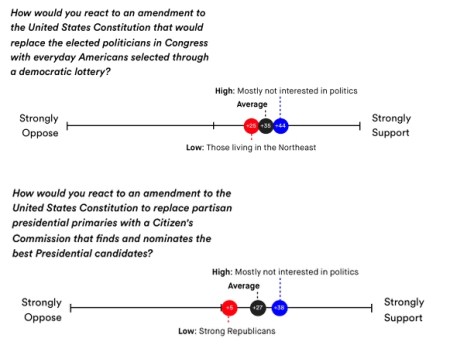
The chart below is excerpted from the results of an opinion survey conducted for “of by for” – an organization working “to get past parties and politicians and put everyday people front and center”. The organization has high profile sortition advocates such as Lawrence Lessig, James Fishkin and Jane Mansbridge as advisors.


 Aug 2, 2020
 This is
 In the context of the recent mass outrage over the murder of George Floyd by a policeman in Minneapolis, Olúfẹ́mi O. Táíwò of the Pan-African Community Action

 Adam Cronkright
 Ali
Ali Ahmed R. Teleb
 avanderven
 avergne
 Alex Kovner
 azakaras
 Brett Hennig
 campbellwallace
 Simon Threlkeld
 Nick Coccoma
 codyhipskind
 Common Lot Sortitionist
 Conall Boyle
 constitutionalism
 davidschecter
 graytmatter
 gtridimas
 H.J. Hofkirchner
 HpR
HpR James Kierstead
 John Burnheim
 jgarry20151
 Jochen Krattenmacher
 johnedwardtaylor
 johnhuang865
 Jonathan Crock
 keithsutherland
 Jacob Richter
 kkoreilly
 lukewhito
 SimonPek
 Nathan El
 Nicholas Gruen
 Owen Shaffer
 Patrick Chalmers
 Paul Gölz
 peterstone
 Pierre-Etienne Vandamme
 pronfeld
 Emil
Emil rcaze
rcaze richwbrown
 Roger Knights
 roslynfuller
 Pierre-Etienne Vandamme
 shaharavin
 tbouricius
 Ted Wachtel
 Joshua Laferriere
 theodorestathis
 towardsautonomyblog
 Wayne Liebman
 Yoram Gat
 Oliver Milne
 Equality by lot