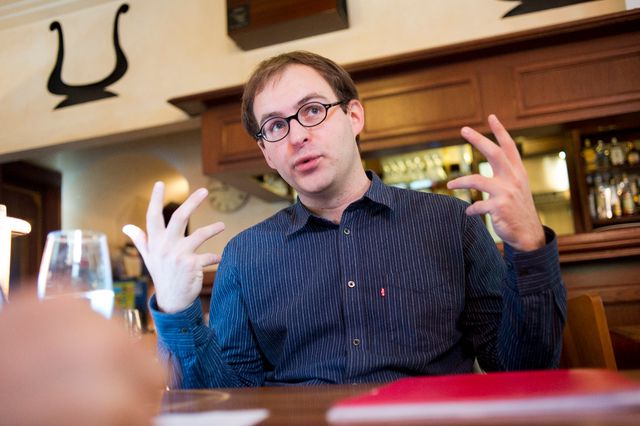
Loïc Blondiaux on a citizen senate


A France Insoumise rally at the Place de la République in Paris, July 3rd 2017, Thomas Samson/AFP

La Croix has a short interview with Loïc Blondiaux on the idea of a “citizen senate”. Original in French here. My translation, corrections welcome.

What could a citizen senate look like?

Compiled by Béatrice Bouniol, Sept. 22nd, 2017

On the eve of the senate elections, Loïc Blondiaux, professor of political science specializing in participative democracy, discusses the idea of citizen senate and the questions it raises.

La Croix: Why does this idea of a “citizen senate” come up in political debates?

Loïc Blondiaux: The idea of a citizen senate indicates two major developments. First, the return to consciousness of the idea of sortition, which was suppressed for centuries. More and more political players and thinkers are considering the possibility of using it in different ways: citizen juries in a more-or-less ad-hoc setting, citizen assemblies aimed toward an institution change or a new sortition-based institution. Secondly, we witness today an increase in proposals that aim to modify the workings of government bodies, to open them more toward civil society and toward discussion with citizens.
Continue reading

Ranciere: What times are we living in?, part 3 of 3

What to save from the drifting French political system? The philosopher Jacques Ranciere was the guest of Aude Lancelin in “The war of ideas” of June 20th, 2017. Here is the transcript of this interview. Parts 1 and 2 of the translation are here and here. [My translation, corrections welcome. -YG]

05. The question today is that of rethinking forms of organization, ways of being together for the long term, outside of the electoral forces.

Aude Lancelin: Your book is also a severe blow to those who today are pinning their hopes on the famous cortège de tête: the group of young people who clash with the police after the demonstrations. You have some ironic words on this subject. For you it is primarily a varnish of radicality which is applied to quite traditional demonstrations. The political meaning of all that and its future are not at all assured in your eyes. Do I misinterpret your thinking?

Jacques Ranciere: First thing: the cortège de tête is not simply the professional revolutionaries who think that it is necessary to radicalize the struggle and who radicalize the struggle by breaking shop windows. There are also people who think that breaking windows is the time of assembly of people who come from different horizons, who come from the political struggle or who come from delinquency in the suburbs, and who suddenly discover themselves. That is a way of gathering people that is classic anarchist or revolutionary politics, and suddenly the people that the movement appeals to and who are involved, who arrive with their own actions, their own revolt or their own ways, are coming first from the world of delinquency rather than from the world of politics. The cortège de tête are not simply people with a specific strategy. Another thing that I am trying to say is that the violent actions of the cortège de tête are also symbolic and not any more strategic in fact than the assemblies of the Nuit debout. Because, in fact, what is it that they are really doing? They take aim at symbolic targets; an ATM, a shop window, a nice car… But that is not at all a strategic action. There is this idea that it is necessary to radicalize, to create an irreversible situation. In my experience, that is not irreversible. It is not that some actions create an irreversible situation. I don’t think that existing conditions create a great realignment. Basically, the question is knowing how to manage this interaction between gathering the greatest number and striking the enemy. But what does “striking the enemy” mean? I don’t really know. I think that in the so-called “radical” thinking, there is always a double logic. On the one hand, the logic of confrontation (“we are going to confront them and it is through the confrontation that we rattle the enemy”) and at the same time a logic of desertion (“if we secede the system will collapse”). In the texts of the Comité invisible there is always this double logic. I think that neither of those two logics is really proven. But I am not trying to give lessons, I am just responding to the questions.
Continue reading

Wariboko: Election by lottery: A new approach to Nigerian democracy

Nimi Wariboko, Walter G. Muelder Professor of Social Ethics at the School of Theology at Boston University, writes:

Electioneering is warfare in Nigeria. Billions of naira are invested in campaigns and conducting elections. War and money have not yielded wise leaders for the country. Is it not time for us to generate creative ideas on how we can peacefully and cheaply select citizens for offices? I suggest that we complement our system of election with lottery. We reserve one-third of all seats in the state Houses of Assembly, House of Representatives, and the Senate for delegates to be filled by lot. Every four years, we put the names of all eligible citizens in a given constituency in a computerised urn or other mechanism and pick out a winner to represent his or her constituency at one level.
Continue reading

Ranciere: What times are we living in?, part 2

What to save from the drifting French political system? The philosopher Jacques Ranciere was the guest of Aude Lancelin in “The war of ideas” of June 20th, 2017. Here is the transcript of this interview. Part 1 of the translation is here. [My translation, corrections welcome. -YG]

03. It is paradoxical to work through institutions in order to demolish them.

Aude Lancelin: Let’s remain with France insoumise and the phenomenon of Mélenchon during the presidential elections. You are very sceptical regarding the figure of a tribune (Mélenchon) who is going to speak in the name of the suffering of the people and champion their cause. This posture is suspect in your view. What is the basis of your criticism?

Jacques Ranciere: There are several things. First, adopting this posture means also adopting the posture that the system imposes, namely the posture that there is an official political game and that there are the people of the depths who are not represented, or are represented by the extreme right from which they must be separated. It is this idea that the people exist, that there are those who represent the people, that is what de Gaulle pretended to do. I don’t think that this is a democratic idea that makes it possible to mobilize and advance. That is the first point. The second point is that I find it paradoxical to become a candidate of the supreme office of the system saying: if you elect me, here is my program. And at the same time to say: but pay attention, this system is bad and therefore everything is going change. I think there is a fundamental contradiction. You are saying to me that my anti-presidential stance is somewhat paradoxical or difficult to follow. But I think it is still more difficult to follow a stance which on the one hand asks to be vested with the powers of the president of the 5th republic and at the same time says I want to 6th republic and i am going to throw all of this up in the air. It is either one or the other. If we say: it is necessary to throw the 5th republic up in the air, we say: I am here to throw the 5th republic up in the air. Period.
Continue reading

‘We spent almost two years sitting on a jury’

There has been some debate on this site regarding the optimal length of service for a political jury.  On the one hand most of those chosen by lot to participate will have had very little political experience, and will need a period of induction and this has led to suggestions for a service period of up to 2 years with overlapping tenure, so that at all times there will be jurors who will have served for at least a year to help guide new inductees. On the other hand others (including myself) argue for short ad hoc juries, allotted for each legislative bill, in order to ensure ongoing representativity (i.e. to combat the risk of jurors ‘going native’).

However the discussion has always been from the perspective of the system rather than the participants who, it is assumed, will go back to their normal lives once their service period has ended. But evidence from a recent fraud trial suggests this may be difficult if the service period is for a year or more. Jurors rarely talk about their court-room experience but four out of the twelve participants in this case have revealed how difficult the transition back to civilian life has been (three of the original 15-strong allotment dropped out, suggesting negative outcomes for nearly one half of the original sequestration). One of the jurors, ‘Julie’

returned to her job in a travel agency when the case finished, but quickly found herself struggling. Julie says: “I went back and did two days training and then I went two days into the shop. I’ve never been back since. I’ve not given it up yet. “I am going through the doctor and trying to get back into it. I’m still struggling. I just felt like I could not even hold a conversation.”

Continue reading

Greece: School flag-bearers will be chosen by lot, rather than achievement

ekathimerini.com reports:

The government has scrapped a long tradition of honoring top pupils by selecting them to carry the national flag in school parades. From now on flag-bearers will be chosen by lot. Opposition parties criticized this as part of the SYRIZA party’s assault on excellence.

A presidential decree published in the Government Gazette on Tuesday sets out the new procedure for selecting flag-bearers, and those flanking them, in primary school parades. Two pupils in sixth grade (the final year of primary school) will be chosen by lot each year, with one serving from the start of the academic year until January 31 and the other from February 1 to the end of the school year.

This means different pupils will carry the flag in parades to mark Independence Day on March 25 and Oxi Day on October 28, which commemorates Greece’s response to an Italian ultimatum in 1940 and the country’s entry into World War II.
Continue reading

Marcela Iacub: To reform political life, long live the lottery!

The French original is here.

The prevalent disgust with the political class will not be resolved as long as the powerful enjoy unwarranted privileges and as long as the president lives in the Elysée palace

It seems that attempting to reform political life brings bad luck. Once the government appointed François Bayrou to draft a law for reforming political life he was quickly paralyzed. Ever since the announcement of this effort, scandals are surrounding the allies and the close associates of the president’s party. Faced with this curse, two explanations suggest themselves.

The first is sociological. The privileges associated with power are shared by practically the entire political class. How then may one find the person capable of putting an end to those privileges? And if by happenstance such a person is found, even the most straight-laced would be surrounded by others who may not be…

The demands of honesty keep increasing year-by-year. That which was common practice suddenly becomes ethically unacceptable, and that which was unethical becomes illegal. Things are moving so quickly that the political class will soon face a crisis. And it is normal. In a democracy, isn’t the gratitude of the people the only privilege allowed? But maybe under those conditions, no one would wish to govern…

For a regime to be really deprived of unwarranted privileges, it must be based on sortition: the rulers are to be appointed in the same way juries are. Everything would then be very different: the political class would simply be a mechanical intermediary and the public in involvement in politics would be strong. Populism would disappear because the citizens would be educated about every question being collectively discussed.

The second reason is psychological. In the current context, the one who is charged with reforming political life is necessarily hated. Not only because he is suspected of hypocrisy – must he not be hiding his own scandals or those of his associates? – but also because the mere idea of “reform” provokes a desire to punish. The entire political class is transformed into a scapegoat for all the collective frustrations. The disgust with the political class is but a mild version of the desire to eliminate it. If it recently benefited the present government, it will soon to turn against it. Can this be doubted?

This is why it is hopeless that the attempt to reform political life will restore the public’s confidence in those who rule over it. It will only further this hate. No sanction will appease the public’s wish to make the power elites pay, to make them fall, to see them suffer. For that to dissipate, the entire system of privileges accorded to the rulers has to be abolished. And above all a profound remaking of institutions has to conceived. Representative democracy has to be reconsidered. It creates the political elites that extract from the people the power to shape their destiny. It is necessary to abolish the material privileges attached to the exercise of power. Today, the most symbolic and the most jarring among those is the fact that the president lives and works at the Elysée palace. Doesn’t this hall signify the unfathomable abyss which separates the rules and the ruled? Aren’t the former nothing but the servants of the sovereign will of the latter? These transformations will make the people, woken from the aggressive apathy toward the ruling elite, re-become a real actor in political life, their hate transformed into delight.

Sortition in Current Affairs

A June 26 Current Affairs article must be the most pro-sortition editorial to appear in mainstream media in recent history. More importantly, it oozes with wit that justifiably pillories America’s “intolerable” Congress. The arguments here are familiar but are combined in an unforgettably entertaining way.

It begins with the sad shape of Congress.

The data confirm that Congresspeople have a lower approval rating than marketing executives and bubonic plague.

Second, it points out that Congress is not “representative” in the demographic sense.

Take our current Congress, which is 80% male, 95% college-educated, and 50.8% millionaires. The population it “represents” is 50% male, 30% college-educated, and 5% millionaires. That’s not even close

It then moves on to the evidence that “representation of interests” is a fantasy, citing Gilens and Page.

If your Congressman (or Congresswoman, but probably Congressman) puts forward the kinds of policies that you yourself would wish to see advanced, why does it matter whether you and he happen to have wildly different backgrounds? That would be an excellent argument, if Congress usually put forward policies that Americans agree with. Alas, it does not. One Princeton study estimates that, statistically speaking, the preferences of 90% of the American electorate have a “near-zero” impact on policymaking. And a number of highly-publicized legal reforms with a broad popular mandate, such as closing the gun show loophole, have never made it anywhere near the President’s desk. How is that possible in a “representative” Congress?

Continue reading

Sortition versus manipulation?

I have been studying the claims that the Trump election was the product of clandestine manipulation of voters by sending them false information so targeted to their personal characteristics as to have a decisive influence on their voting behaviour.

The data firm Cambridge Analytica claims to have profiles of nearly everybody in the USA, based on information about them collected from the internet. These profiles enable predictions of a very high accuracy of what sort of information will be accepted by particular people and what influence it will have on their voting. It is not very likely that such manipulation would induce many Democrats to change their vote, bit it might leave them less likely to turn out for Hillary. It could easily account for bringing fringe Republicans to vote. The Trump campaign spent relatively little on conventional media. They got so much free! But they are said to have spent heavily on covert manipulation.

A first reaction is that we have another argument against voting and all that goes with it in current practice. But further reflection reveals a danger even to sortition. The members of a body chosen by sortition can be identified and their prejudices cultivated to pervert their view of the facts they are considering. It need not be very expensive, since they are relatively few in numbers, and well worth the cost to a body with big interests at stake. It would be more attractive than lobbying in many circumstances.

The only remedy I can see is insistence that all the proceedings of public decision-making must not only be available to all, but open to comment at every stage so that untruths are challenged and patterns of deceit uncovered.

Sortition-related proposals in Belgium and Switzerland

In Belgium, Christie Morreale, a senator, proposes a Peonidisesque scheme where blank votes would be translated into allotted MPs.

In Switzerland “Génération nomination” is starting to collect signatures for putting its sortition-related proposal on the ballot. According to the proposal, 50 out of the 200 members of the Swiss national council would be selected by lot.